
Save this guide and work through it step by step
Start with the quick-start section, complete the checklist or worksheet, then write down one decision and the next action.
Free score and resource
Get your score before you download
Answer 4 questions, then enter your email to receive Local SEO audit triage checklist, your full result, and the next-step plan.
No spam. Unsubscribe in one click.
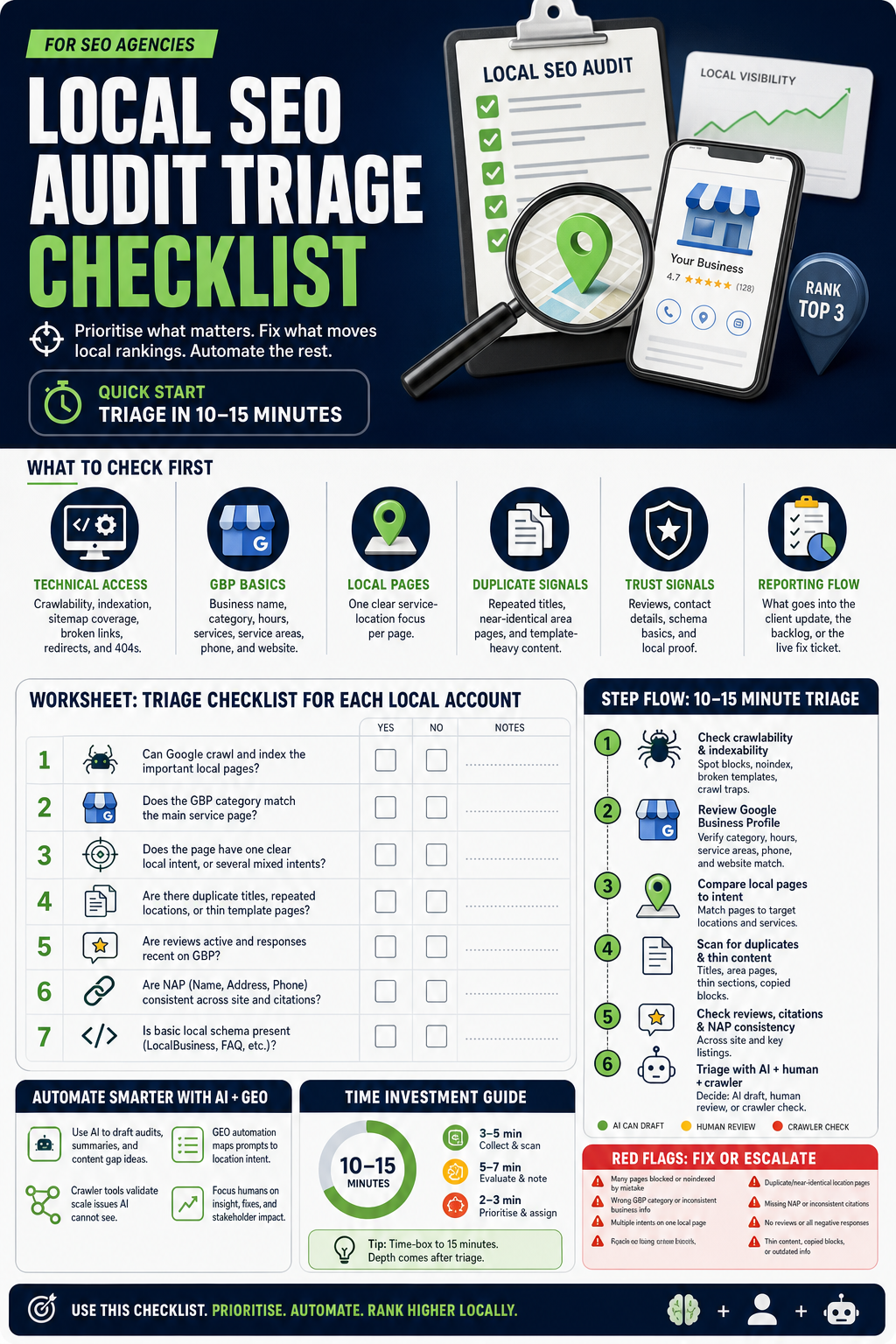
Quick start: triage in 10 to 15 minutes
If a local account is slipping, do not begin with a full audit. Triage first. Your goal is to sort issues into three buckets: fix today, queue for later, or automate safely.
- Check crawlability and indexability. Note blocked pages, noindex tags, broken templates, or obvious crawl traps.
- Review the Google Business Profile for category, hours, service areas, phone number, and website match.
- Compare the main local landing pages against the target location and service intent.
- Scan for duplicate titles, repeated location pages, thin sections, and copied blocks.
- Check reviews, citations, and NAP consistency across the site and key listings.
- Decide which checks can be drafted by AI, which need human review, and which need crawler validation.
This approach protects time, budget, and client confidence. It also reduces the risk of sending a polished report that misses the real issue.
What to check first
Use this order when you need the fastest useful answer.
- Technical access: crawlability, indexation, sitemap coverage, broken links, redirects, and 404s.
- GBP basics: business name, category, hours, services, service areas, phone, and website.
- Local pages: one clear service-location focus per page.
- Duplicate signals: repeated titles, near-identical area pages, and template-heavy content.
- Trust signals: reviews, contact details, schema basics, and local proof.
- Reporting flow: what goes into the client update, the backlog, or the live fix ticket.
Work from access outward. When crawl and index issues are clean, content and citation findings are easier to interpret.
Worksheet: triage checklist for each local account
Use the table below as your working sheet. Keep the evidence short and the action clear.
| Area | Check | Evidence | Action |
|---|---|---|---|
| Technical | Crawl and index status | Blocked pages, noindex, errors | Fix now or defer |
| Site | Location page coverage | Missing pages, duplicates | Create, merge, or keep |
| GBP | Profile completeness | Category, hours, services | Edit now or review later |
| Trust | Review pattern | Volume, recency, response gaps | Escalate or monitor |
| Signals | Citation consistency | NAP differences, outdated listings | Correct or leave |
Checklist prompts for notes
- Does the page have one clear local intent, or several mixed intents?
- Does the GBP category match the main service page?
- Is the primary phone number identical on site, GBP, and key citations?
- Is duplicate content a template issue or an editorial issue?
- Does the page need a human rewrite instead of automated text?
- Is there any technical error blocking crawl or confusing priority?
- Which findings can be batch-processed across accounts?
- Which checks should repeat weekly, and which should be monthly?
Decision framework: automate, review, or keep manual
Not every local SEO check should be automated. The safest use of AI is pattern work: grouping issues, drafting summaries, and surfacing inconsistencies. Judgment calls still belong to a human.
| Task | Method | Why | Do not choose if |
|---|---|---|---|
| Broken links | Automate | Clear rule-based check | You need context-heavy diagnosis |
| Duplicate titles | Automate | Easy to detect at scale | Titles depend on brand nuance |
| GBP message fit | Review | Needs local context | The profile wording is already approved |
| Local page quality | Review | Requires editorial judgment | The page is a simple template with no nuance |
| Final client priority list | Manual | Commercial impact matters | You are only collecting raw findings |
Simple rule: automate checks with stable answers, review checks with context, and keep manual any decision that changes scope, quality sign-off, or client messaging.
Worked example: a UK plumber with weak local visibility
Imagine a plumber serving Leeds, Headingley, and Horsforth. Traffic is flat and the client wants more local enquiries.
You triage and find four issues. The service page is indexable but thin. The GBP category is correct, but the service list is incomplete. Three citations show an old phone number. The Leeds page repeats the homepage wording.
Your next steps are straightforward: fix the phone inconsistency, rewrite the Leeds page with unique local proof, complete the GBP services, and mark the remaining pages for duplicate review.
In this case, AI can help draft the issue summary, group duplicate pages, and prepare the client note. A human still decides what gets rewritten, merged, or kept.
UK local context for agency delivery
For UK accounts, check how the site and profile reflect local market reality. The same account may need a different approach in London, Manchester, Birmingham, Leeds, or Bristol. A service-area business often needs different handling from a single-location practice with postcode-level intent.
Before you change anything, compare the live site, the Google Business Profile, and the strongest local directories in the same market. That helps you separate a real location issue from a listing mismatch.
Red flags and common mistakes
- Do not treat an AI summary as proof. Check the crawl output, source page, or profile directly.
- Do not automate everything at once. Start with repeatable checks and keep the rest under review.
- Do not compare tools by one feature only. Compare workflow fit, data quality, and reporting output.
- Do not send a long list of issues without ranking them by impact and effort.
- Do not ignore template problems. They often create repeated issues across many local pages.
- Do not leave duplicate location pages unlabelled. Decide whether to merge, rewrite, or remove them.
The biggest risk is false confidence. If the output looks neat but cannot explain what to fix next, it is not helping.
Final action checklist
- Check crawl and index status before reviewing content.
- Record the top five local issues by likely impact.
- Compare GBP, site, and citation details for consistency.
- Decide which checks can be automated safely and which need manual review.
- Write one clear action per issue: fix, rewrite, merge, monitor, or defer.
- Prepare a short client summary that separates urgent fixes from backlog items.
- Set a repeat schedule for the checks that catch drift early.
- Use the completed triage sheet as the base for the next account review.
If your team needs a reusable next step, keep this checklist as the standard intake format and route follow-up work through your normal delivery workflow.
Related articles
Sources
- Free SEO Audit Checklist: Track Your Page Audit
- Local SEO Audit Process, Template & Client Report Example