Save this guide and work through it step by step
Start with the quick-start section, complete the checklist or worksheet, then write down one decision and the next action.
Free practical resource
Get the complete resource by email
Enter your email to receive Content brief template with QA checkpoints and a short practical follow-up sequence.
No spam. Unsubscribe in one click.
SEO agencies in the UK do not need another vague briefing note. You need a structure that helps you compare a topic, record the right signals, and decide what a writer should produce before drafting starts. That is the fastest way to reduce revision cycles, missed intent, and scattered planning.
This page gives you a usable template for SEO consultants working with AI SEO and GEO automation. It is built to help you turn one messy topic into a brief a strategist, writer, or reviewer can follow without guessing. The precision matters: define the goal, match the intent, choose the angle, and lock the quality checks before you write.
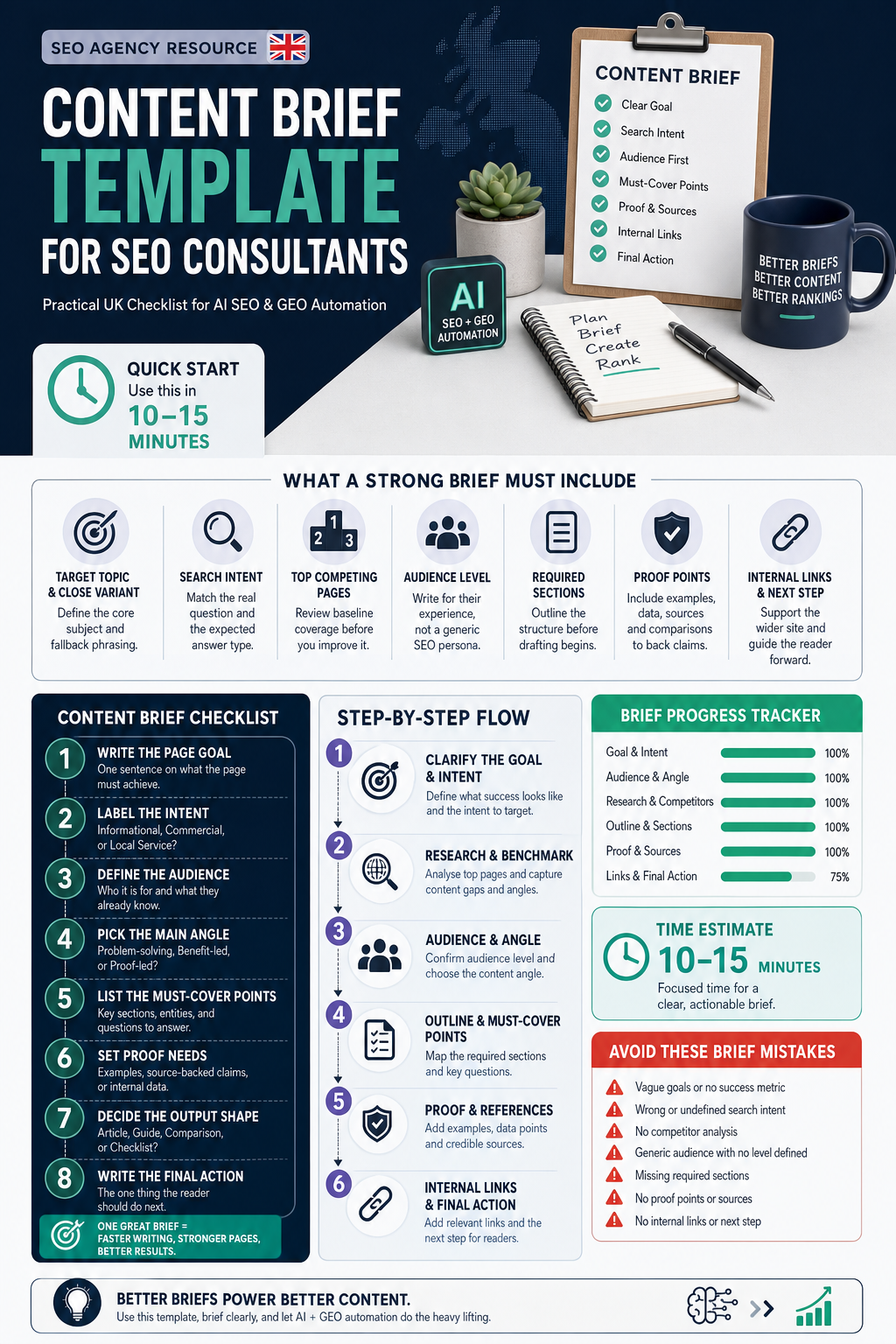
Quick start: use this in 10 to 15 minutes
- Write the page goal: one sentence on what the page must achieve.
- Label the intent: informational, commercial, or local service.
- Define the audience: who it is for, and what they already know.
- Pick the main angle: problem-solving, benefit-led, or proof-led.
- List the must-cover points: sections, entities, and questions.
- Set proof needs: examples, source-backed claims, or internal data.
- Decide the output shape: article, guide, comparison, or checklist.
- Write the final action: the one thing the reader should do next.
If you can complete those eight steps, you already have enough structure to avoid the most common AI-generated drift.
Template worksheet
| Field | What to record | Good sign | Red flag |
|---|---|---|---|
| Goal | One outcome sentence | Clear business result | Too broad |
| Audience | Who will read it | Specific role | Generic persona |
| Intent | User need | Matches query | Mixed intent |
| Angle | Main promise | Useful and distinct | Vague benefit |
| Proof | Evidence to include | Checkable | Unsupported |
Use the worksheet as a gate. If one row is weak, fix it before writing. Weak inputs create weak briefs, and weak briefs create rework.
What a strong brief must include
- Target topic and close variant so the writer knows the core subject and fallback phrasing.
- Search intent so the page answers the actual question, not a guessed one.
- Top competing pages so you can see the baseline coverage before you improve it.
- Audience level so the copy fits the reader’s experience, not a generic SEO persona.
- Required sections so the outline is visible before drafting begins.
- Proof points so claims, examples, and comparisons can be checked.
- Internal links or next step so the page supports the wider site.
- Quality check so the final page answers the query without filler.
According to practical briefing guidance from Siteimprove and SEOClarity, effective briefs connect business goals to search intent and reduce expectation gaps between strategist and writer.
Comparison framework: which briefing approach fits?
| Approach | Strength | Limitation | Best fit | Do not choose if |
|---|---|---|---|---|
| Manual | High control | Slower | Sensitive topics | Speed is the priority |
| AI-assisted | Fast setup | Needs review | Repeatable pages | Accuracy is untested |
| Hybrid | Balanced pace | Needs process | Agency teams | No reviewer is available |
Decision rule: use manual briefs when the page is commercially sensitive or unusually complex. Use AI-assisted briefs when the structure is repeatable and the review process is tight. Use hybrid briefs when you want speed without losing editorial judgment. For many agency workflows, hybrid is the safest default.
Worked example: UK agency service brief
Imagine a London-based SEO agency offering AI SEO and GEO automation. The goal is to attract agency buyers who want faster content planning without losing editorial control. The intent is commercial investigation, so the brief should not read like a generic educational article.
Example decisions:
- Goal: generate qualified enquiries from SEO agencies that need faster brief production.
- Angle: show how the workflow reduces drafting time and missed content gaps.
- Proof: include one practical example, one process summary, and one quality-control step.
- Sections: problem, process, comparison, mistakes, final action.
- CTA: route the reader to the main site after the page has answered the decision question.
For UK context, names like London, Manchester, Birmingham, and Leeds are useful only when they change the decision. Do not stuff them in; use them to clarify service fit, delivery expectations, or market scope.
Red flags and common mistakes
- Do not record only keywords; a brief without intent and audience is just a list.
- Do not compare by one feature; speed alone can create more editing work later.
- Do not skip proof checks; unsupported claims usually surface during review.
- Do not overbuild the outline; too many sections blur the main point.
- Do not leave the next action vague; every brief needs an endpoint.
- Do not assume AI knows the brand voice; give examples or guardrails.
Typical failures come from vague scope, weak intent matching, and missing quality control. Fix those first, and the rest becomes easier to manage.
Final action checklist
- Check that the goal, audience, and intent are written in one place.
- Record the angle, proof needs, and required sections.
- Compare the brief against the top competing pages.
- Decide whether the brief should be manual, AI-assisted, or hybrid.
- Prepare the handoff with links, notes, and source checks.
- Review the outline for gaps before drafting begins.
- Confirm the final reader action and make sure the brief supports it.
Use this resource now: fill in one live client brief today, then compare the result against your current process. That single test will show where the time savings and quality gains are real.
Next step: Use the template to structure your next SEO brief, then send the completed version through your agency workflow for review and approval.
Related articles
- Agency AI workflow scorecard for margin, speed, and quality
- A UK-Focused Guide to Integrating AI Tools into an SEO Agency Workflow
Sources
- Best AI Agents for SEO: Tools, Guides, and More
- 10 Best AI SEO Agency in 2026 (Compared by SEO Experts)